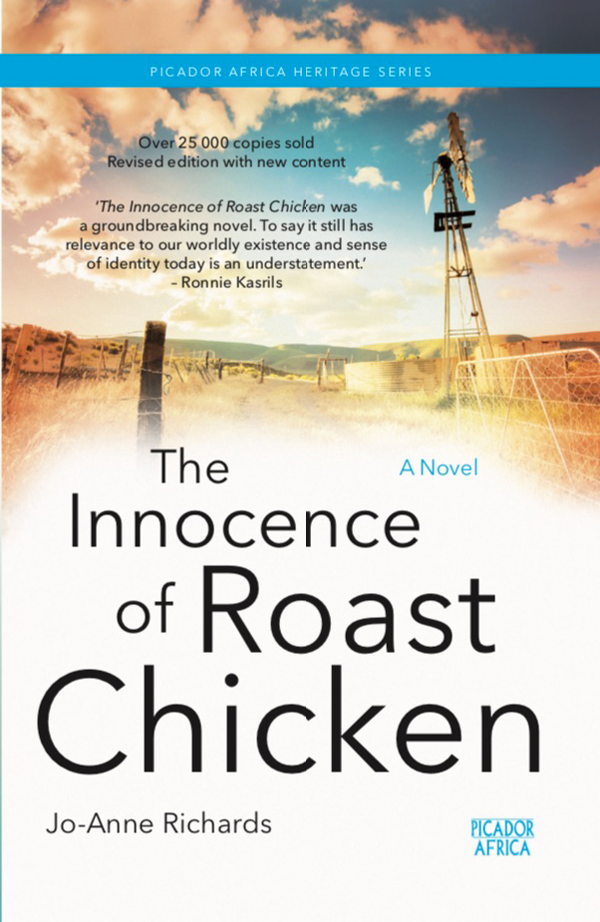
The Innocence of Roast Chicken
A fresh and memorable addition to the literature of apartheid. – Observer. (UK)
The Innocence of Roast Chicken focuses on an Afrikaans/English family in the Eastern Cape and their idyllic life on their grandparents’ farm, seen through the eyes of the little girl, Kate, and the subtle web of relationships that is shattered by a horrifying incident in the mid-1960s.
Scenes from Kate’s early life are juxtaposed with Johannesburg in 1989 when Kate, now married to Joe, a human rights lawyer, stands aside from the general euphoria that is gripping the nation. Her despair, both with her marriage and with the national situation, resolutely returns to a brutal incident one Christmas day when Kate was thrust into an awareness of what lay beneath her blissful childhood.
Beautifully constructed, The Innocence of Roast Chicken is painful, evocative, beautifully drawn and utterly absorbing.
Author's Note on The Innocence of Roast Chicken
The Innocence of Roast Chicken defined me. It’s the book that transformed me into a writer. Yet, nothing could have prepared me for its reception when it first appeared. Its success knocked me sideways.
Somehow, it managed to hook into the zeitgeist of the time. And, I guess it must still have relevance today since it hasn’t disappeared into the void where old novels go to die. First published by Headline Review in London in 1996, it was rereleased in 2019 as part of the Picador Africa Heritage Classics collection, alongside works by Nelson Mandela, Ellen Kuzwayo and Frank Chikane.
In the week it was first released, the book shot to number one in South Africa, and remained there for fifteen weeks. It drew excellent reviews, and appeared as the ‘Dark Horse’ on a London bestseller list, alongside Graham Swift’s Last Orders and Hogfather by Terry Pratchett.
It was nominated for a prestigious international award and chosen as an ‘outstanding debut novel’ by a British bookshop chain. I launched in London, toured the UK, spoke in Europe, sold the film rights, and found myself recognised in the street — a strange sensation for someone who’d spent her twenties dogged by doubt.
The level of attention the book received gives some indication of the way it engaged the consciousness of general readers and intellectuals, both positively and negatively. It made people think. It caused a stir.
It wasn’t about me, though. In the late ‘90s, my book was part of a broader context, following our liberation from apartheid in 1994. Cabinet Minister Ronnie Kasrils noted, at the time, that Innocence ‘broke the paradigm’ and ‘helped to define the time’.
‘Your book,’ he said, ‘is what this country is all about.’
Perhaps it should not have come as a surprise. The decade before had resounded with calls for our artistic impulses to bow to the political. In 1987, JM Coetzee referred to a literature in bondage, unable to move beyond its preoccupations with power, to the ‘vast and complex human world that lies beyond them’.
Njabulo Ndebele drew attention to how little attempt there was to grapple with the minutiae of motive or social process. ‘People and situations are either very good or very bad.’
Our first free elections ushered in a new spirit and a new age. In this burst of artistic freedom, writers like myself, no longer constrained, shifted radically from prescriptive representations, in favour of a real attempt to describe flawed human lives.
It may well have been this attempt in Innocence that elicited such a response. This was a debut novel, for which I drew on little more than my instincts as a loving reader. Yet, somehow, it managed to tap into the mood of this new age.
Our nation had been through the worst of times, so perhaps the harshness of my protagonist Katie’s coming of age resonated with local readers. But, mostly, readers expressed to me their weariness with ‘struggle writing’ and its didactic intent. They were drawn to books that told them a story.
For writers, this meant we were able to glance backwards, acknowledge the past, but turn to the future, with hope.
So, this is not a novel ‘about’ apartheid and its immediate aftermath. It’s about ordinary people being tested by extraordinary times. And we are still being tested by extraordinary times.
Our innocence is constantly being pitted, in an unequal contest, against the universal forces of greed and venality. We continue to lose our innocence and fall into despondency.
This was a condition I intended to resonate through the novel – the swing in public sentiment between euphoria and hopelessness. It is my attempt at a plea for balance; the recognition that both extremes are unsustainable and only a degree of equilibrium allows us to live, ultimately, without despair.
The Innocence of Roast Chicken transformed my life from the ordinary – sometimes gloriously, sometimes absurdly. When I sold the film rights and was flown to Pinewood Studios in London, I was warned by the producers that a famous US actor was filming on set – under contractual instructions that no one who came across him was permitted to meet his eye. Ever the rebel, I announced that I’d do it anyway. (Who did he think he was?)
‘Then you’ll be wrestled to the ground by his body guards,’ I was told. Sadly, I never did encounter him, since I was dying to put it to the test.
It didn’t matter. My life, just then, needed no more animation than it already had.
Far more important than all this excitement was what it gave the young woman I was then, riven by insecurity. Pride. It gave me the courage to move forward with a literary and academic career, teach others to write, complete a PhD, and write more books.
That’s what the novel did for me personally. Since that handful of ‘new’ writers appeared in the early 1990s, the South African literary landscape has become full and diverse. Men, and women, of all colours, creeds and cultures produce narratives, personal and otherwise, in a wide range of genres. It has become a rich literary landscape.
To have contributed to this vibrant post-apartheid literary scene makes me more than proud. It has given my life meaning and worth.
Reviews: The Innocence of Roast Chicken
‘It was the time of politics with a capital “P” when everything had to relate to the liberation struggle and the overthrow of apartheid in far too prescriptive a manner. Yet the very title of Jo-Anne Richards’s debut novel caught my imagination, so evocative of the Sunday roast chicken of my childhood days, that when I bumped into her at a government reception I spontaneously told her, “Your book is what this country is all about.” This was when a young white woman was not supposed to be the literary flavour of the month. The self-styled literary commissars were outraged. The author was either ahead of her time or her critics were shackled by the ideas of political correctness, race and gender identification. The Innocence of Roast Chicken broke the paradigm. It helped to define the time, giving insight from where some of us had come, and it pointed the way to what we could become. That’s what great writing should accomplish.’
- Ronnie Kasrils
On its debut The Innocence of Roast Chicken was the perfect herald of South Africa’s transition; it remains an enduringly lyrical and evocative landmark novel, both coolly rational and achingly nostalgic in its depiction of the beloved country
- Finuala Dowling
This novel tells an intensely personal story and offers in the process a perspective on the changing South Africa which reveals again the dramas of apartheid. Jo-Anne Richards’ writing seems effortlessly expressive and flows with an unerring feel for authentic detail – to give us a fresh look at a familiar story
- Wendy Woods.
Kate is a white South African with an attitude. While her human rights lawyer husband Joe is starry-eyed about the unfolding of the new South Africa, she relentlessly mocks it. In uncovering the mystery of why Kate is as she is, the story shifts between two worlds: the rural idyll of her grandparents’ chicken farm in 1966 and Johannesburg in 1089 . . . this book has pace and tension – shot through with the terrible beauty of the South African landscape and the efforts of a child to stave off a gathering evil
- Gillian Slovo, Mail on Sunday
The Innocence of Roast Chicken explores the psyche of a damaged nation. Richards’s confessional tone mirrors the current political climate in South Africa, where a nation is having to examine its past, in order that it may look forward to the future. More importantly though, Richards first novel is a personal narrative, which absorbs the reader into her drama, and the tragedies which unfold
- Anna Worthington, Literary Review (UK)
Jo-Anne Richards displays a wonderful feeling for place and period . . . her prose is sharply evocative, and she conjures up the child’s powerful feelings with a vividness intensified by nostalgia
- Margaret Walters, The Sunday Times (UK)
A rapturous and tactile evocation of dust, food, noises and a childhood domain, rendered with a marked empathy for the child and the magical properties of a child’s stamping ground
- Elizabeth Buchan, The Times (UK)
Richards has a marvellous eye for tiny, telling details. The writing here is often lyrical, quite beautiful in its evocation of simple things keenly felt. There are passages reminiscent of the best of the early Lessing and they give Richards’ prose and edgy, disturbing quality that reaches pitches of remarkable brilliance. It shines. She has the knack of finding exactly the right word
- The Star
Jo-Anne Richards has the writer’s eye, that natural ability to sniff out the telling detail and the right word. She is a delight to savour – one of the freshest voices to emerge from South African literature in years
- Peter Godwin, author of Mukiwa.
It is a painful excursion into the frankly scandalous as Richards tries to relate history’s ineptitude to the way that we see things now
- Business Day
Is niet alleen een belangwokkende roman omdat hij zo goed geschreven is
- Het Parool, Amsterdam
Neither martyrs nor heroes, Richards’s ordinary folk are loyal and optimistic – and naïve and self-important. Not many writers would have been in a position to criticize the great liberal cause before 1989-90.With luck The Innocence of Roast Chicken will help pave the way for a new genre of simple and honest South African story-telling
- Guardian. (UK)
More from Jo-Anne

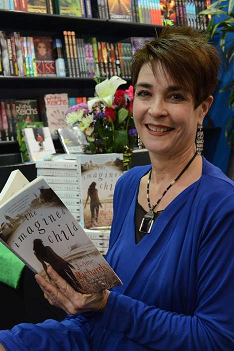
The Imagined Child
Odette, a soap-opera scriptwriter, moves to the small Free State town of Nagelaten hoping to leave the chaos of Johannesburg — family trouble, a fraught relationship, a brush with violent crime — behind her. To the town, she appears to be a woman quietly recovering from heartbreak. They have no idea what she’s really running from.
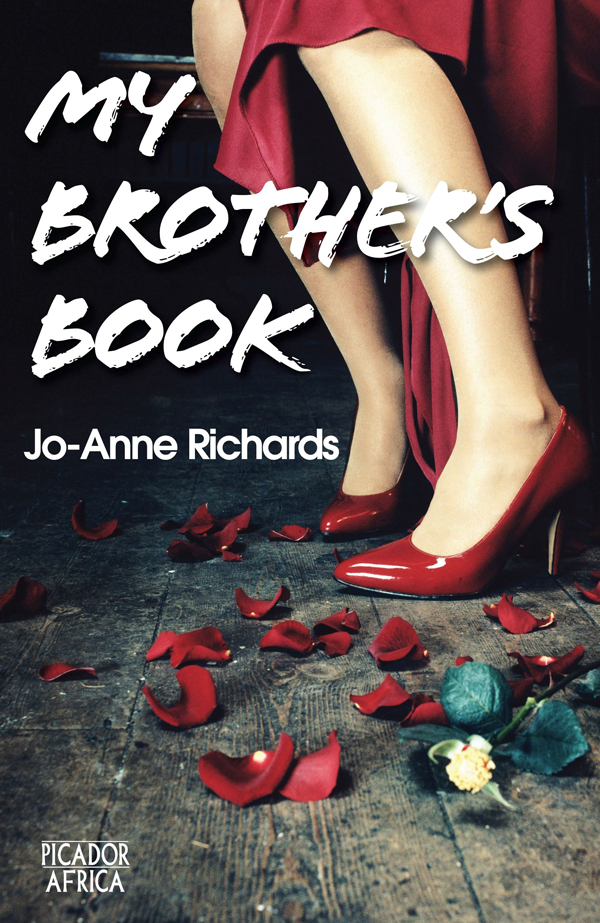
My Brother's Book
I was born on page 23 of my brother’s book. On page 52, before the whole world, I betrayed him. Spanning two siblings’ lives from a nomadic 1960s childhood to an uneasy adulthood in 2004 Johannesburg, this is a story of betrayal and atonement — and of a brother and sister forced to reconcile their fierce love with thirty years of anger.
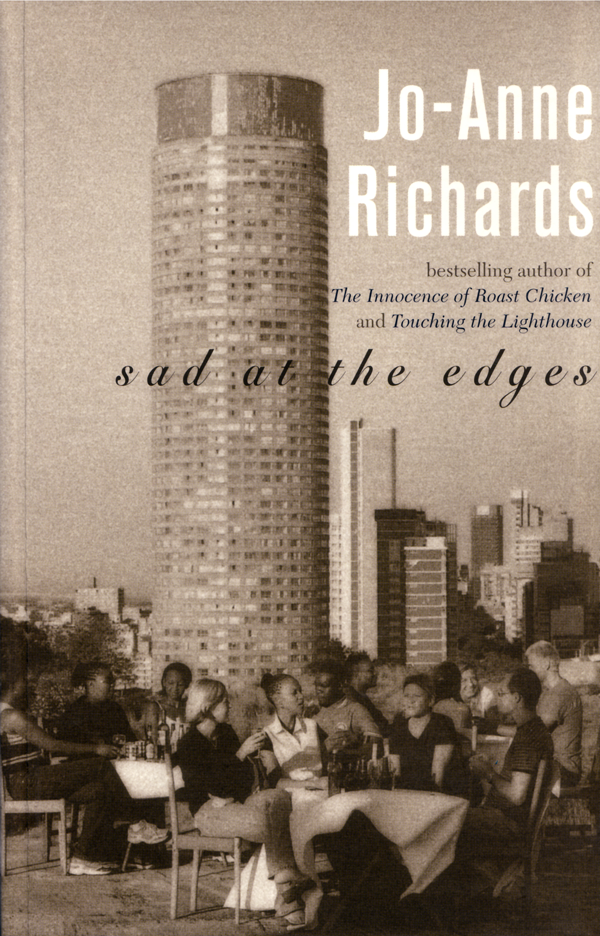
Sad at the Edges
Megan returns to Johannesburg from London to find her cousin Francesca using the appearance of an ordinary life to mask a darker past. As the city — restless, vivid, caught between euphoria and disenchantment — pulls them both into its extremes, Megan and Francesca are dragged toward a reckoning neither quite wants. A story of hope and recovery, told with the lyricism of The Innocence of Roast Chicken.
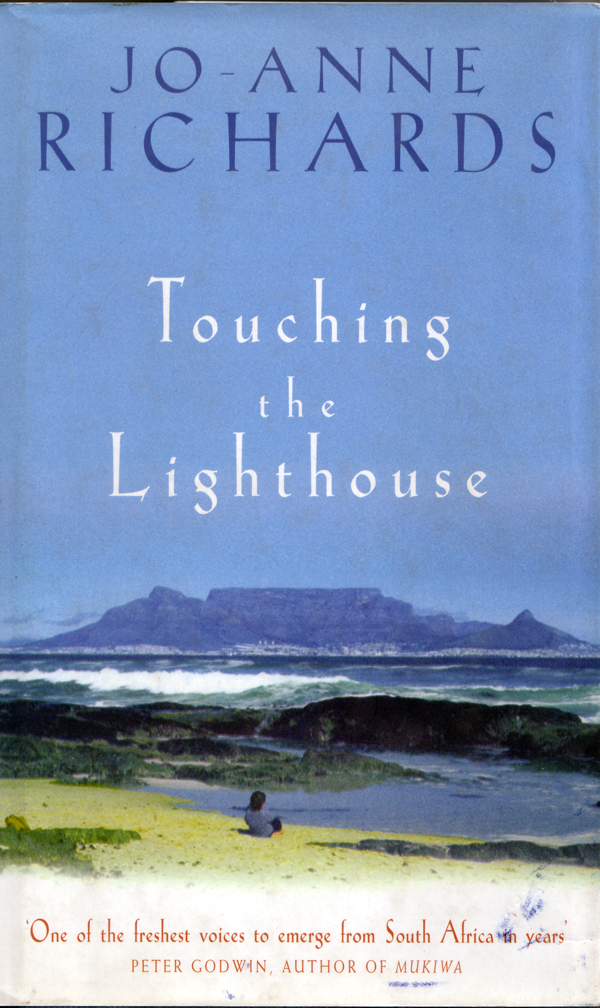
Touching the Lighthouse
Susan and Jennifer are two young women in search of their adult selves, in a South Africa charged with the tension of historic change. Their reckless passion finds an unsettling foil in Maud, their cleaner — perhaps the only one who can see where their futures are really headed. A worthy successor to The Innocence of Roast Chicken, written with the same acute sense of place and time.